Every so often companies latch onto the next big thing. In the late 90s it was websites and then it was Facebook pages. For the past decade it has been apps.
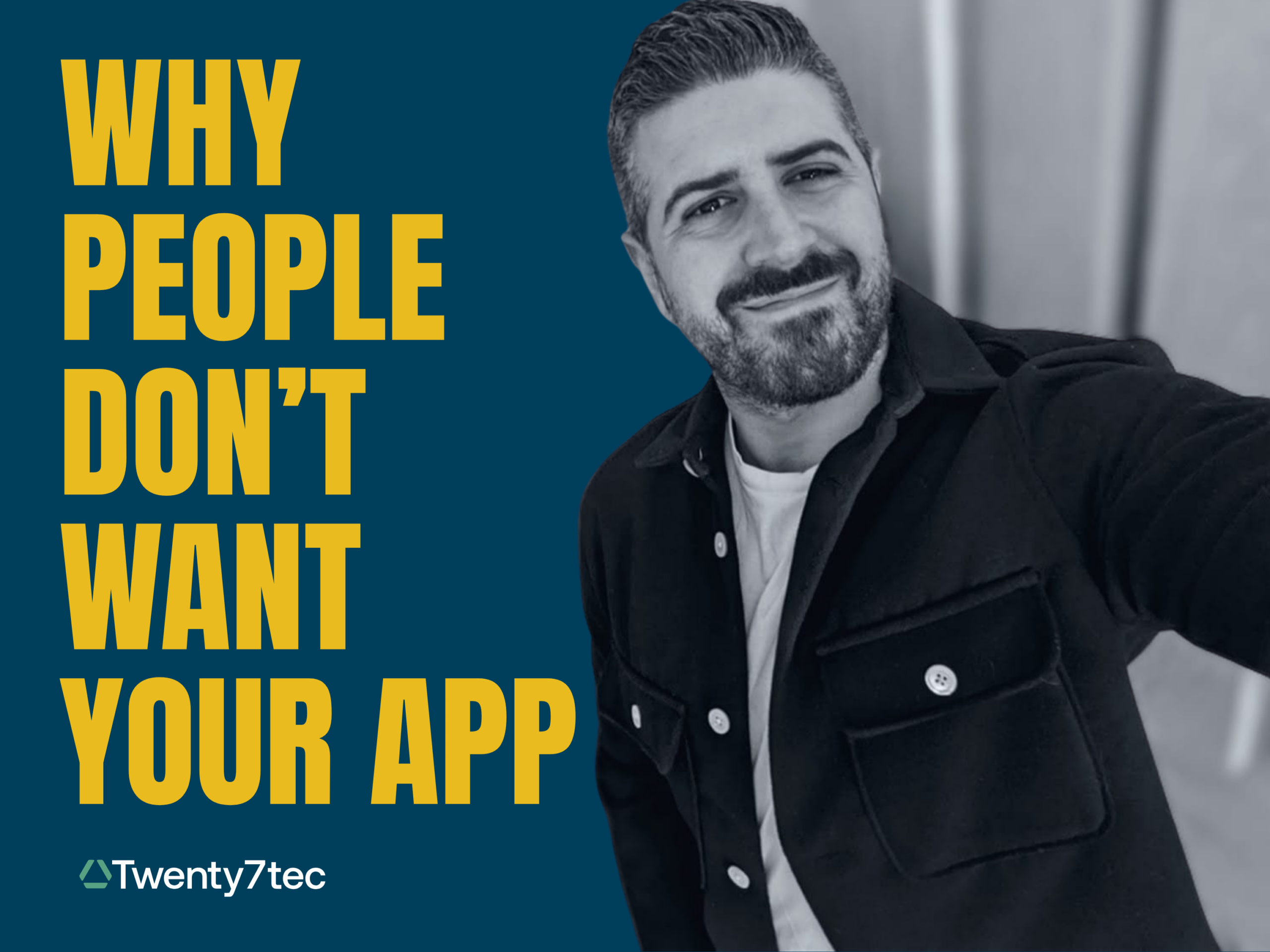
The problem is however, that most people don’t want your app. Not really. They want what your company provides: the service, the product, the connection. The app itself is just another thing getting in the way.
When you send someone to the App Store, you are asking them to stop what they are doing and take a detour. That is where you lose them. Forbes found that 91% of users hate being forced to install apps just to do business. That is not just friction. That is a dead end. The journey you worked so hard to build is gone in a second.
A long time ago I used to work with healthcare systems where we had to map out every step of a process and ask if it was a “value added activity” for the end user. Doing that for a long time means I find it really hard not to do this anymore. When you look at app installs through that lens, the whole process is full of waste.
Think about it:
- Redirected to the app store, which might not even load
- Out of storage, can’t install
- Bad signal on the train
- Not signed in to the Play Store
- An app with no reviews, or one that looks suspicious
- Security warnings about data or encryption amongst others
- The store trying to divert your attention to something else shiny
Each one is a reason to drop out. And then even if the user downloads the app, they may never open it. And if they do, now they must create an account, sign in, deal with MFA and permissions. More hoops. More chances to walk away.
And here is the bigger problem: human attention does not wait. If something takes too long, people switch. They start another task, open another tab, reply to a message. By the time the download finishes, you have already lost them. Google’s research shows that 53% of users abandon a site if it takes longer than 3 seconds to load. Adding an app store trip and a download on top of that is asking for abandonment.
All of this is noise. None of it gets the customer closer to what they came for.
The Web
The web is different. The journey starts there and it just continues. There are no breaks. No detours to an app store. No switching vehicles. You are already in the right place, and the flow carries you forward to where you want to go.
What makes this even more powerful is how far the web has come. Ten or fifteen years ago, web apps were clunky. They were slow, limited, and could not compete with native experiences. That is no longer true.
Modern web apps can feel just as smooth and responsive as native apps. They can send push notifications, work offline, integrate payments, use the camera, support biometric login, and be installed to the home screen with a single tap. For most intents and purposes, they feel native, but without the baggage.
The only time you really need to go native is if your product depends on hardware-specific traits of the device: deep camera functions, high-end gaming graphics, or advanced sensors. If you are not building for those cases, the web gives you the reach and the speed without the baggage.
And that is the point. With the web, the user does not have to do anything extra. They just keep going. The journey flows, and the value is right there.
Apps Are Not Bad
This does not mean “apps are bad”. They have their space, especially when firms are dealing with scale and repeat business is expected. I use Amazon all the time, so of course I go to the app. It’s set up, it has my cards, my preferences, everything is ready. That makes sense.
But most services are not Amazon. They are not as sticky. For one-off purchases or small services, people will not install an app. Apps work for repeat business of established brands. For almost everyone else, the web is the better path.
You also have to ask yourself if building an app is really strategic, or just a bit of a vanity project. It looks cool to see your logo in the App Store, but does that mean you have made it? As a business, you have made it when you have created a journey that works. One that gets people from start to finish without losing them along the way. It is a tough question to ask, but you must track the things that matter.
Beyond the User: Business Risks
There is a business reality that often gets ignored. If you sell services through an app, you are giving a cut to Apple or Google. Both take up to 30% of every transaction through their stores. Even advice-based services can be hit by this rule. That is a huge chunk of your revenue for simply using their platform.
Control is not really yours either. Apple and Google can remove your app from the store at any time. They can force updates on you within timeframes you cannot manage.
The web avoids all of that. No cut of your revenue. No middleman with a kill switch. No forced updates just to keep access to your customers. You own the journey from start to finish.
The Takeaway
Forcing people into native apps no longer fits the way software spreads today. People do not want hurdles. They want access.
If you want something that lasts, do not try to demand loyalty up front. Earn it by making the experience so useful and so easy that people want to come back.
That is how you build journeys that work. That is how you build businesses that last.
About the Author
Jon Guerra-Fernandez is a Product Specialist with over a decade of experience building technology solutions in fintech and financial services. He has led product delivery across multiple large data platforms, client portals, mobile hardware/software development and customer engagement tools, with a focus on making complex journeys simple for end users. Jon is passionate about design, usability, and cutting through noise to create digital experiences that actually work for people.